Visit our website: www.jsicoatings.com
Call: (936) 321-3333
Email: steve@jsicoatings.com
Showing posts with label Case study. Show all posts

Thursday, July 25, 2013

Field Joint Coating for a 48" Pipe Road Bore

What do you do when you've got a 48" road bore and you 
are in charge of selecting the field joint coating material?  

     I recently had a call from a customer who had a real problem.  He was in charge of a directional drill involving a 48" OD pipe.  Due to some issues with the right of way; his staging area was very, very small.  He really only had enough room to weld and coat two joints of pipe at any given time.  As a result, they were going to be completing the bore in stages; pulling two joints of 48" pipe into the bore and then stopping while they welded and coated the next two joints.  After this; those two joints would go into the bore (4 total) then they would have to stop and weld/coat two more.

     This presents two major problems.  First; the starting and the stopping during the bore can put really extreme forces on the pipe; the factory applied coating and the field joint coating...especially with a 48" OD pipe!  A 48" OD pipe can weight anywhere between 190 and 250 pounds per FOOT.  That means that a 20 foot pipe joint weighs in at a whopping 3800-5000 pounds.  That is a heck of a burden for a field joint coating (or any coating) to bear! 

     The other problem is due to the minimal staging area; the contractor wasn't going to have time to wait for products to cure.  Imagine that they were using a liquid epoxy that required 16 hours to cure...they would only get two joints completed per day!! (possibly less if they ran into trouble with spray equipment / repairs / etc). 
48" Directional Drill
DIRAX shrink sleeves - even a 48" OD pipe is no problem.

     Though these are pretty significant problems for most coatings; for the DIRAX it wasn't a problem at all.  DIRAX shrink sleeves have been used on 48" pipe in the past with no problems.  It is built exactly for those kinds of incredibly challenging applications.  Beyond that; though the DIRAX shrink sleeve system does utilize a liquid epoxy (S1301M) it doesn't have the same cure times that stand alone liquid epoxy pipeline coatings experience.  Thanks to the heat put into the pipe during the preheat and thanks to the heat put into the pipe during the sleeve installation; the epoxy has been largely cured by the time installation is completed.  No long wait times; no real problems...just one more seemingly complicated directionally drilling application that DIRAX heat shrink sleeve solves with no problem!

Friday, May 24, 2013

Pipeline Repair - Case Study

    
How many 'near miss' pipeline catastrophes occur each year?
     Last week, there was very nearly another major pipeline disaster in the southeastern United States.  Under ground, a high pressure, natural gas line has been in service for many years.  This pipeline is coated with coal tar (paper and all) and is doing exactly what it was designed to do.  If we're being honest, this line is doing more than it was ever asked to do; as the coatings applied 30+ years ago have prevented corrosion better and longer than the original engineers required them to! (Click HERE if you're interested in reading an article summarizing Coal Tar as a pipeline coating).

     In any case, this pipeline was quietly doing its job when WHAM.  A construction crew laying a new pipeline in the area accidentally gouged the side of the pipe; significantly damaging sections of the coal tar and (in a few cases) causing bare steel to be exposed.  My understanding is that there was no meaningful damage to the pipe wall itself.  Isn't that incredible all on its own?  A pipeline coating that was 1/4 of an inch thick (or there about) was completely scraped from the pipe in some cases; but the pipe itself was undamaged.  I've heard football described as "a game of inches" many times; but in this particular case 'Life' was a game of inches; as who could predict what might have happened if the back hoe had struck the pipe hard enough to cause a break in the steel; a spark; a disaster.  I imagine the crew was wide eyed when they realized what had almost just happened.

     All of this resulted in a fairly common phone call to us at Joint Specialists.  On the line was a man in the field; he had a representative from the gas company on the line as well.  The question was "I've got significant damage to an active natural gas line - what do I need to do to repair this coating?" 

     I walked them through the options (as discussed here) and we quickly came up with a custom solution and application procedure for getting the pipeline coating back intact as quickly, easily and reliably as possible.  Crisis averted.  Pipeline service not interrupted and hopefully the end user will get another 25 years out of that coal tar coated pipeline!


Friday, May 17, 2013

DIRAX vs Tape vs 3 Layer Sleeve - Case Study

     A few years back, we were given a great opportunity.  The east Texas field office of a United States gas company was interested in evaluating DIRAX.  They had a relatively short (160 foot), 4.5" OD directional drilling application they were going to be carrying out and they were going to evaluate DIRAX sleeves; Cold Applied Tape and a Three Layer System similar to HTLP60.

     Installations were completed based on manufacturer's recommended installation steps and the drill was begun.  In this particular case, we were presented with a VERY interesting hiccup.  Half way through the bore (meaning half way through the pipe's journey through the bore hole), there was a break down in equipment.  As a result, the pipe had to be pulled out of the bore hole (backwards).  At that point, the following photos and conclusions were reached:

Road Bore Case Study
Cold Applied Tape after road bore attempt

directional drill
Cold Applied Tape is MIA after road bore.
     A couple comments here.  First, as you can see, the cold applied tape was not put on a field joint; it was instead installed on top of FBE (as can be seen in the picture).  Second, this is not an attack on Cold Applied Tapes; I am not aware of any Cold Applied Tape manufacturer who claims their product should be used for a road bore application, so this is not a surprising result -- this is an expected result.  Third, as can be seen, the Tape is completely gone (some threads of it still hang from the pipe in the bottom left section of the bottom picture.

     Next is the Three Layer PE Sleeve system (similar to Covalence HTLP60).  This product incorporates a liquid epoxy layer, a hot melt adhesive layer and a cross linked (but not fiber reinforced) PE backing.  There are manufacturers out there who recommend, promote and sell products similar to this as a technically sound option for the field joint coating of road bore pipe.
failed road bore coating
The three layer sleeve did not survive the road bore fully intact.

A close up of the result of the this three layer sleeves encounter with a rock or root during the bore.
     This product did do some things well, on the half way forward then back out journey.  It stayed in place.  It did not experience any wrinkling.  It did not experience pull back or peel.  Unfortunately, either on the way in...or the way out; this product did experience a collision with a rock or a root which resulted in a gouge being taken out of the coating.  It is difficult to see here; but this gouge did reach the bare steel of the pipe. 

     To be clear, we would not recommend a simple three layer sleeve system like this one for a road bore or directional drilling application; for this exact reason.  There are cases where a customer asks for an option that is more cost effective than the DIRAX, but we cannot in good faith offer a sleeve system like this.  Compare the cost saved by using a cheap coating for a road bore with the cost of addressing a corrosion problem underneath a road a few years down the line...there is no comparison.  Spending the money on the RIGHT coating now (DIRAX) will save tens of thousands of dollars down the road.

     Finally we will look at our DIRAX sleeve.  The DIRAX sleeve system consists of a liquid epoxy; a high shear hot melt adhesive and a mutli layer PE backing which includes a fiber reinforcement.  The same sleeve material is then installed on the leading edge of the pipe (called a 'leader strip' or 'wear cone') which gives the most environmentally challenged piece of the shrink sleeve extra reinforcement during the pull through.  As far as I know; the fact that this product was pulled backward out of the bore; without any kind of a leader strip in place was the first trial of its kind.
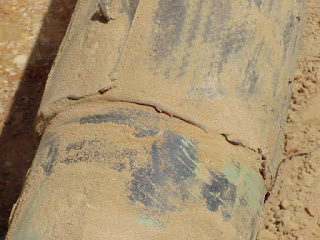
DIRAX Unscathed
DIRAX is intact; compared to adjacent epoxy and FBE
    Above; we see the 'back end' of the DIRAX sleeve.  This is the end that was supposed to have been reinforced with the leader strip.  In this case, the DIRAX survived beautifully.  The sleeve has not 'lifted up'.  The dirt has not found its way under the sleeve.  The DIRAX sleeve has not been torn; abraded or penetrated (the flap at the top left of the this picture is the closure strip - more on that below).  In comparison, the FBE and the liquid epoxy (as seen just below the DIRAX) have experienced tremendous force.  The liquid epoxy has been scratched completely away in several areas.  It is difficult to tell; but the FBE (single layer) also experienced significant abrasion and damage. 
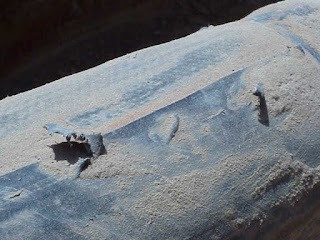
Closure
The closure strip has no corrosion coating responsibility. It's function is complete upon install.
     Here we see the only question that the Gas Company had about the DIRAX sleeve system. This is the closure strip (WPCPIV).  Every wrap around shrink sleeve must use a closure strip of some kind.  The closure strip is used to hold the sleeve in the shape of a tube during the shrink process.  For the DIRAX (and other hot melt adhesive sleeves) the closure serves absolutely no purpose after the sleeve has been fully installed and the sleeve has cooled to ambient temperatures.  In the picture above, we see two tears in the closure strip likely caused by a rock or root along the path.  This damage did not effect the DIRAX sleeve underneath the closure.  A force tough enough to tear through the cross linked closure strip had absolutely zero impact or effect on the DIRAX sleeve.  Remarkable. 

     After this trial, the end user was convinced.  It would be nothing but DIRAX on the field joints of road bored and directionally drilled pipe for them, and we had we had this field trial to thank for it.

Wednesday, May 8, 2013

The Great Trans-Alaska Pipeline - a Case Study from Raychem's Perspective

“I don't think it's a secret to anyone that the trans-Alaska pipeline, the terminal at Valdez, is a critical asset not only to the state but the country. It's stating the obvious - that this pipeline plays a critical role in this nation's economy.” - Eric Gonzales

 
420 miles of the 800 mile Trans Alaska Pipeline are above ground.

     (The following is one tiny slice of the history of the Trans-Alaska pipeline told by a man who was there.)

     The year was 1974 and Alyeska had an incredibly large problem on their hands.  Their pipeline had been delayed for years as politicians argued about environmental impact studies, labor disputes and land ownership questions (and probably argued about what was in it for their constituents).  At that time, Fusion Bonded Epoxy (FBE) was a somewhat 'new on the scene' pipe coating and manufacturers and applicators were both learning their way through some kinks. In any case, the FBE coated pipe that had been patiently waiting in pipe yards scattered around Alaska had, unfortunately, not been coated with an FBE designed to withstand several years of UV exposure.  Imagine that for a second; 380 miles of 48" OD pipe sitting in a pipe yard...and the factory applied coating is experiencing massive failures due to UV degradation.  I have to believe this resulted in many sleepless night for those responsible for the integrity of that pipeline.

The Dalton Highway which runs (at times) parallel to the pipeline.
       Now let's look at this same problem from another perspective; that of the somewhat fledgling technology company; Raychem Corp.  The year was 1974 and Raychem had an incredibly large opportunity on their hands.  Scattered across Alaska were 380 miles of 48" OD pipe, coated with failing FBE.If Raychem could engineer a solution for this incredibly difficult problem, Raychem would cement their place at the top of the heat shrinkable pipeline coatings world and leave their mark on one of the greatest pipeline projects of all time.


A beautiful partnership is born in 1974.
     So, the problem as it stood was re-coating 380 miles of 48" pipe; in the field; faced with sub-zero temperatures; installed on top of a failing coating; using a product backing that did not yet exist; using an adhesive that did not yet exist; installed with equipment that did not yet exist and having this all completed within a time frame that did not dramatically compromise the timing of the project.  Raychem's response:  "No problem."

     Raychem had already been established as a leader in heat shrinkable technology and specialty adhesives.  They didn't have the perfect products already created, but they did have a solid base of proven technologies to work from.  It was determined early in the process that the timeline for this project needed to be 6 months or less (keep in mind, that was 6 months to production so it would have to include training the different pipeline crews and qualifying the product).

     It was also decided early in the process that the best solution was going to be a heat shrinkable, spirally wrapped tape product.  Raychem had never manufactured a tape product before!  So the team (led by one of the great corporate leaders of all time, Paul Cook) got to work conquering this mountain.  The product which was eventually used was called Arcticlad (and was similar to another product called Rayclad that continues to be used today!).  

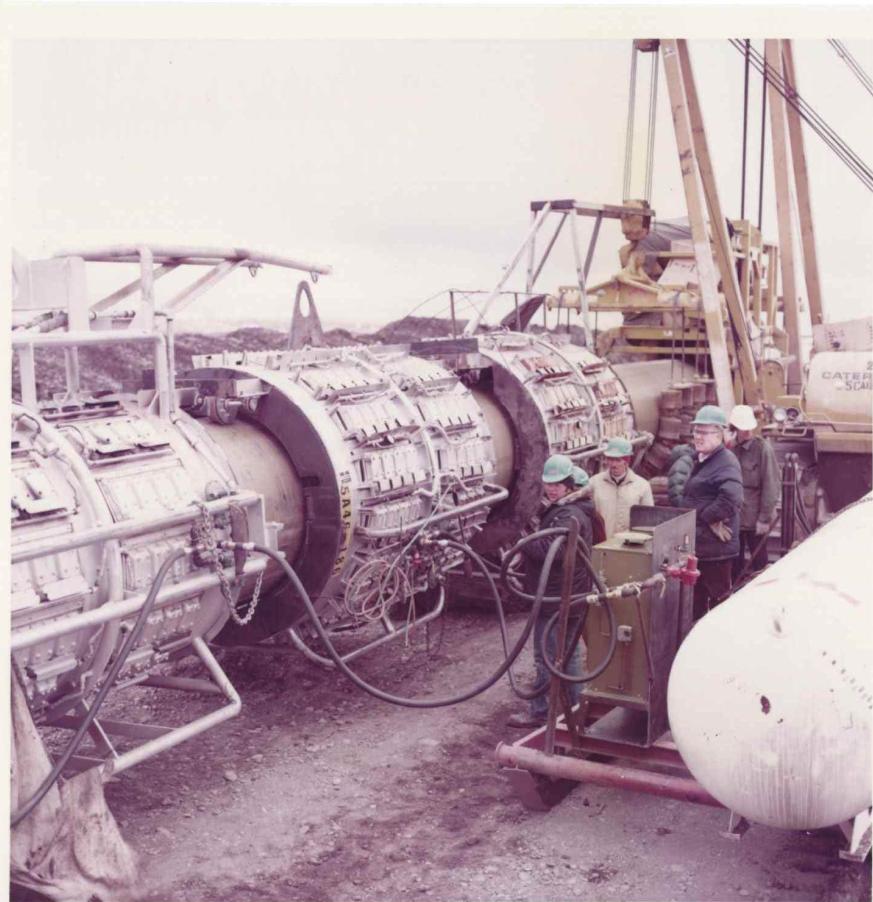
     As one team was working on developing and perfecting the Arcticlad, another team was busy engineering the machines that would clean the pipe; preheat the pipe; wrap the Arcticlad and then shrink the Arcticlad.  Quite a tall order.  Starting at the beginning, machinery was built that encapsulated the pipe and had numerous wire brushes working to knock any lose or disbonded FBE from the pipe.

The machine at the far right of the picture is the specially designed pipe cleaner.
     The next step in the process was the preheating station.  In order for the Arcticlad to properly bond to both the bare steel (where the FBE had disbonded) and to the still bonded FBE, the bond line temperature needed to be ~225 Fahrenheit.  Quite a challenge to raise the temperature of a 48" pipe from below zero; up to 225 in a reasonable amount of time.  Custom heaters (sometimes as many as 8 or 10 used at a time) were designed for just this purpose.

The four silver objects between the two side booms are the heaters.
     Finally, the Arcticlad would be spiral wrapped using a specially engineered tape wrapping machine.  The heat of the pipe (from the machines above) was sufficient to to create adhesive flow and put the Arcticlad backing into a state of crystalline melt; which resulted in the adhesive filling, flowing and forming a homogenous layer which acted as a sealant and offered some physical protection for the pipe.  
A close up of the wrapping machine, and the Arcticlad pay off.
A picture of the finished product.  Well done, Raychem!
     In the end, the project was successfully completed.  The six month time frame was kept.  Alyeska was able to salvage and still use their pipe in spite of the damaged coating; and Raychem was able expand their business into the oil and gas pipeline market with what turned out to be a $23 million dollar project (which would be more than $100 million in 2013 dollars!).  Thirty eight years later this pipeline is STILL in service!  

     As an added bonus, the new technologies Raychem had created to solve this problem were able to be transitioned into entirely new (and leading) product lines.  Modern products (currently under the Covalence Seal for Life heading) including ambient temperature wrap around shrink sleeves; factory applied line coatings; closures; road bore sleeves; high temp wrap around sleeves and others can all trace their ancestry right back to the mid 1970's.  

     One man's problem is another man's opportunity.  Isn't that a beautiful thing?