Visit our website: www.jsicoatings.com
Call: (936) 321-3333
Email: steve@jsicoatings.com
Showing posts with label WPC120. Show all posts

Tuesday, December 10, 2024

WPC120 - High Temp Heat Shrink

 High Temp Heat Shrink for Pipelines

WPC120
Covalence WPC120


     In the world of pipeline coatings, many different factors are important criteria for selecting the proper external corrosion prevention coating for your project. These can range a great deal, depending on the priorities for the engineers associated with any given pipeline project.  One thing never changes though:  the pipe coating must be compatible with the operating temperature of the pipeline.

     Elevated temperatures on pipelines can present quite a challenge to pipeline coatings.  Elevated temperatures can make some products become brittle.  High temperatures can make adhesives and sealant soften, leading to reduced peel, sheer and penetration resistance.  Temps can also lead to cracking and worse cathodic disbondment results.  "What is the operating temp of the line once it is in service" is almost always my starting point when working with someone to be sure our products are properly specified.  

     Covalence WPC120 is a heat shrink sleeve rated for use on pipelines operating at up to 251F.  WPC120 can also be used on pipelines operating at something less than 251; that is just the maximum.  Available in sleeve widths of 11", 17", 24" or 34" (can also offer custom widths as needed) it is the perfect selection for pipelines operating at high temps.

     Though WPC120 is not compatible with factory coated PP; with a few modifications, it becomes a sleeve system called PPS120 that can.  Give me a call so we can discuss your next project!  Steve - 936/321-3333

Monday, November 25, 2024

Temperature Ratings for Covalence/Raychem Heat Shrink Sleeves

 Temp Ratings for Covalence / Raychem Heat Shrink Sleeves for Corrosion Prevention

     I've found that often conversations about the product are more valuable than simply looking at a website.  I'd love to chat with you about this:  Steve 936/321-3333

    But now, looking at the various maximum temperature ratings for various Covalence / Raychem shrink sleeves:  we are basing these on maximum operating temperature of the pipeline.  In many cases, a pipeline project may list something like "maximum design temperature" and "expected operating temperature".  Very often, coatings are selected that will be able to meet the "maximum design temperature."  Occasionally, a client of ours will direct us to ignore 'max design' and instead quote based on "expected."  That is their choice of course.  

     So from here, I'm looking specifically at the flip side:  what is the maximum operating temperature of a pipeline with specific regard to our coatings (which is actually based almost wholly on the ratings of the adhesive used on that coating. 

WPCT - 140F

WPC65M - 150F

WPC100M - 176F (212F offshore or under insulation)

WPC120 - 251F

HTLP60 - 140F

HTLP80 - 176F

TPS - 140F

    To reiterate:  conversations about your project are MUCH BETTER than simply plugging in something you've read; so please call me to discuss!!


Thursday, April 18, 2024

Lead Time for Covalence Shrink Sleeves

 Lead Time for Covalence Shrink Sleeves


      Once upon a time, Covalence Heat Shrink Sleeves were called RAYCHEM (many people still remember that name:
     Since 1989 we have been a stocking location for Raychem (now Covalence) Shrink Sleeves.  We specialize in a few things:
  • We are knowledgeable about the product
  • We keep a large stock of inventory
  • We try to ship all orders out within one day
     So, lead times are generally very SHORT.  A few of the Covalence products that we stock and make in our facility in Conroe, TX 77385:

  • DIRAX - directional drilling field joint coating
  • WPCT - basic mastic shrink sleeve rated for use up to 140F
  • WPC100M - mastic shrink sleeve rated or use up to 212F (in some circumstances)
  • WPC120 - hot melt adhesive shrink sleeve rated to 251F
  • TPS - WPCT in a slip on / tubular form
  • Caseal - high expansion sleeve for sealing between a casing and a carrier pipe
  • Flangeseal - high expansion sleeve for protecting a flange
  • Flexclad - heat shrink tape
  • HTLP60 and HTLP80 - three layer coating system
  • S-1301m Epoxy that is used with products like DIRAX and HTLP
Give us a call with any questions!  Would love to chat about your next project!  936/321-3333


Thursday, March 21, 2024

Covalence WPC120 In Stock - IMMEDIATE SHIPPING

 Covalence (Raychem) WPC120 IN STOCK!

    Covalence WPC120 is our highest rated PE shrink sleeve in terms of operating temperature of the pipeline it is designed to protect the field joints on your pipelines that will operate at up to 251F (120C).  That is pretty much the maximum temperature that a PE can be used.  

     Designed to work with FBE, PE and other common pipeline coatings; WPC120 CAN be used with PP as well, but it requires some additional components to create a coating system rather than a simple single shrink sleeve coating.  

     Available in widths of 11", 17", 24", 34" or something custom, whatever you need we can make it happen (but 34" is the max). 

     Currently I have thousands of feet of WPC120 on hand, ready for your project (that you likely forgot to order the shrink sleeves for!).  Give me a call to discuss how I can help you get out of a bind....even if you just need a few hundred sleeves quickly to get your project started.


Steve@jsicoatings.com ----- 936/321-3333

Thursday, February 1, 2024

Pipe Coatings IN STOCK!

 Pipe Coating Materials IN STOCK 

Same Day Shipping Available

"DO YOU HAVE PRODUCT _______ IN STOCK????"

     That right there ^ is by far the most common question I receive from folks.  In the pipeline world, the products that we are are often the very last item purchased for a project (and too often, pipe is already welded and crews are standing around before we are called."  So - here is a list of the different products that we stock at our facility in Conroe, TX.  I'll give a very brief (hopefully only 1 line) description of each product.  

WPCT - in 11", 17", 24" and 34" widths.  WPCT is a standard wrap around shrink sleeve designed for use on pipelines that will operate at or below 140F.

WPCPIV - in any width you'd like.  WPCPIV is the closure strip that holds shrink sleeves together during the installation process.

WPC120 - in 11", 17, 24" and 34" widths.  WPC120 is rated for use at 251F.

WPC100M - in 11", 17", 24" and 34" widths.  WPC100M is rated for use at 176F (212F offshore)

WCSM - heavy wall heat shrink tubing rated for use at 1000 volts for cables.  We stock:  12/3; 16/4; 24/6; 34/8; 48/12; 56/16; 70/20.  We stock all in 4 foot lengths; but can supply you with a custom length if needed.

TWDB - 3" and 4" wide in 165 foot rolls.  Thermofit Wraparound Duct Bands for high velocity industrial HVAC systems and vent hoods.

TPS - Tubular Pipe Sleeve (slip on) for 2", 2.5", 3.5", 4.5", 6" and 8" pipe.  Rated for use at 140F.

S1301M Epoxy Primer - two part epoxy component of many Covalence shrink sleeve systems.

DIRAX - in 3", 12", 17", 24" and 34" widths.  The best product for road bores, directional drilling applications, pilings, etc.

Powercrete R95 - the High Build Epoxy - 2# kits, 4# kits, 50ml repair cartridges -- and custom kit sizes available.

Powercrete R65/F1 - the Fast Cure Epoxy - 1# kits, 2# kits, 4# kits, 50ml repair cartridges and 400ml spray cartridges available.  In addition - we can offer you a custom kit sizes for your next project.

Powercrete J - The Original Road Bore Epoxy - 2# kits, 4# kits, 10# kits.  In addition - we can offer you a custom kit sizes for your next project.

PERP - Polyethylene Repair Patch for repairing damage to PE coatings.

MWTM - medium wall shrink sleeve for cables.  We stock:  16/8; 50/16, 85/25

HTLP80 - 11", 17", 24" - three layer PE system for lines operating at up to 176F

HTLP60 - 11", 17", 24" - three layer PE system for lines operating at up to 140F

GHFC - snap on seal for cable splices

GelWrap - 18/4-100 - snap on seal for cable splices

Flexclad - 2" wide, 3" wide and 4" wide - heat shrinkable tape sold in 50 foot rolls

5# FBE Repair Sticks - green FBE repair sticks that are commonly used (though I recommend you use Powercrete R65/F1 50ml cartridges instead -- they are dramatically superior in every technical way.

CS / Caseal - high expansion material for sealing between a carrier pipe and a casing pipe

FS / Flangeseal - high expansion material for sealing a buried flange.

CPSM 195/102-1500/87 - high expansion tube supplied at 7.67" that will shrink down to 4".

BPTM 30/12; 50/20; 100/40 - busbar insulation tubing

ASE-4 - Anode Splice Encapsulation Kit

AC - Anode Sealing Caps for 2", 3" and 4" anodes.

BBS - bundled bumper system for protecting lines during a multi-pipe pullback for pipelines 8" and larger.

BBS/CCS - bundled bumper system for protecting lines during a multi-pipe pullback for pipelines less than 8"
Tuesday, January 19, 2016

WPC120 Shrink Sleeve

High Temp Shrink Sleeve WPC120

120C shrink sleeve
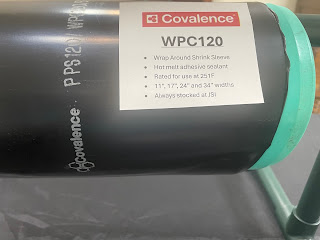
Rated for use at 120C (251F) WPC120 is our highest rated shrink sleeve
     WPC120 heat shrinkable wrap around sleeves are designed for corrosion protection of girthwelds on buried pipelines operating at temperatures up to 120C.  WPC120 sleeve have a thick radiation crosslinked polyolefin backing coated with a high shear strength thermoplastic hotmelt adhesive.  during the installation the adhesive melts and flows, filling surface irregularities, bonding to metal and adjacent coated surfaces.
   
     At operating temperatures the adhesive and backing form a solid, tough, well bonded coating.  The flexible closure is coated with a high shear strength adhesive and is normally supplied separately with the sleeve; however, it is available pre attached to the sleeve in the unisleeve construction.

     To install, wrap the sleeve around a clean, preheated pipe (230C minimum).  A flexible closure forms the sleeve into a tube.  The sleeve is then torch shrunk and installed with simple tools.  No powder, primer or sophisticated equipment is required.  However, an induction heater can be used to reduce preheat time.

     WPC120 sleeves resist abrasion, impact and penetration, yet remain flexible even at very low temperatures.  No rock shield is required.

     WPC120 sleeves resist temperature cycling, soil stresses and hydrostatic pressure.  They demonstrate high resistance to ultraviolet light, fungus, cathodic disbondment and chemical attack by common fluids and solvents.  WPC120 sleeves are compatible with FBE, PE and most other high performance pipe coatings (but not PP unless a mastic material is used as the bonding agent).  The product has a long shelf life and is unaffected by typical storage conditions.


Wednesday, December 3, 2014

Shrink Sleeve Backing Properties: Part 2

Backing Properties of Shrink Sleeves:  Part 2

     Yesterday we started looking at this topic, primarily considering the different types of heat shrinkable backings and the practical aspects of the different characteristics under which a backing can be evaluated.  (Backing Properties of shrink sleeves: Part 1 can be found here).

     Today, we are going to look at the physical properties of the backing on two different Covalence shrinkable sleeve products:  WPC120 and WPC100M.  As a quick overview, WPC120 is a shrink sleeve rated for use on pipelines operating at elevated temperatures (up to 120C / 251F).  WPC100M is a heat shrink sleeve system that is used on pipelines that will operate at up to 120C / 212F.  In some ways, two specialized products....but in other ways, examples of the product quality that is available in the Covalence heat shrinkable product line.

WPC120 Backing Properties
Tensile Strength - ASTM D-638 - 2700 psi @ 23C / 660 PSI @ 120C
Elongation - ASTM D-638 - 580% @ 23C / 560% @ 120C
Shore D Hardness - ASTM D-2240 - 57
Shrink Force - ASTM D-638 (150C) - 45 psi
Dielectric Strength - ASTM D-149 - 800 volts/mil
Moisture Absorption - ASTM D-570 - .04%
Impact Resistance - ASTM G-14 - 75 in-lbs
Penetration Resistance - ASTM G-17 - No Holiday with 12kV detector @ 120C


WPC100M Backing Properties
Tensile Strength - ASTM D-638 - 3400psi
Elongation - ASTM D-638 -350%
Shore D Hardness - ASTM D-2240 - 55
Shrink Force - ASTM D-638 (150C) - 40 psi
Dielectric Strength - ASTM D-149 - 1000 volts/mil
Moisture Absorption - ASTM D-570 - .04%
Impact Resistance - ASTM G-14 - 50 in-lbs
Penetration Resistance - ASTM G-17 - No Holiday with 10kV detector @ 80C


Tuesday, January 21, 2014

High Temp Offshore Field Joint Coating

Had a meeting recently where an engineer was writing a specification for an offshore pipeline that will operate at a high temperature (121C).  The line will be coated with a three layer polyethylene coating and the infill would be an SPU (and obviously the line is concrete coated).   His question:  what should I use as a field joint coating on this high temp, offshore pipeline -- and why should I use Covalence Shrink Sleeves?

In addition, his initial leanings were toward a three layer system utilizing a PP (polypropylene heat shrink backing) - but at the same time, his own initial evaluation was that maybe he'd just use our WPCT product (which is designed for ambient temperature pipelines!)  

Here are some of my thoughts:

Anytime a pipeline is going to be operating at 121C, it narrows the field down considerably (as a quick aside - WPCT is only rated for use at 108F so would absolutely not be approved for use on a line this hot).

If this were my line - the first product I would consider is WPC120 (click here for product specific information about WPC120).  WPC120 has a long successful use history all over the world.  It has been used often both onshore and offshore.  It has excellent technical properties and is very field friendly. 
Now I want to bring up a few things at a time here.  Your preliminary drawing indicates a plan to use an epoxy / PP sleeve system.  First, I'm wondering why you are leaning that way?
I understand that utilizing an epoxy as the primary corrosion coat can be a commonly made decision.  But at the same time, I wonder if it is really necessary.  You must consider that using an epoxy offshore can present a significant challenge.  The epoxy has a short pot life (depending on the scope of the project - you may or may not be at a quantity that would make bulk epoxy an option cost wise).  In addition, painting on the epoxy requires time.  In addition, it is possible you will need to force cure the epoxy (which means both extra time - and having an induction coil available) prior to installing the shrink sleeve. 
So, is the epoxy truly necessary?  The facts (as I see them) are that epoxies certainly improve shrink sleeve performance.  That cannot be argued.  Epoxies improve cathodic disbondment results (sometimes), they improve shear strength and peel strengths (sometimes) but in this case, the shrink sleeve is going to be subsea, underneath 30mm of SPU, while the concrete bears the weight of the pipeline.

I say all of that to point out that there is a definite cost to utilizing the epoxy as a layer (material cost, time, equipment, labor, etc) - and I'm not sure the technical advantage is truly worth that cost.
In addition, you are specifying a PP backed sleeve.  That is a bit unusual.  I understand that PP exhibits better abrasion resistance than a PE typically does (and sometimes lesser heat aging properties), but in this case, abrasion resistance really becomes a non-factor.  This sleeve is going to be underneath 30mm (or more) of SPU.  I don't expect that the shrink sleeve will ever be exposed to abrasion.
It looks like in the drawing, you have the sleeve spanning from the taper of one side to the taper of the other side (it could also be an option to run the shrink sleeve from PE backing to PE backing which (in my opinion) would be the better choice...assuming that doesn't cause any problem for your infill contractor.
Now - looking at sleeve widths.  If you are simply running from 1 taper to the other taper - you will need a shrink sleeve that is ~27" wide (686mm) (would need to know final tolerance levels before actually quoting something). 
If you were going to try to run the shrink sleeve from (near because of tolerances) one concrete to the other concrete; you would require a shrink sleeve that is ~33" wide (838mm).
So what would the advantages of the WPC120 product be?

The WPC120 requires no special equipment other than high powered torches.

The WPC120 requires no epoxy - this lowers costs; install times; storage space; potential field problems; potential material shortages; etc.

WPC120 can be easily and readily cut to a custom width with minimal (or no) extra charge
WPC120's backing comes complete with Raychem's patented PCI (Permanent Change Indicator for Shrink Sleeves).  This is an accurate measure for installers and inspectors that the shrink sleeve being properly and evenly heated.  There is no question.


Wednesday, October 9, 2013

WPC120 / PPS120 High Temp Shrink Sleeves

WPC120 / PPS120 

      WPC120 (also sometimes called PPS120) is our highest rated (temperature) heat shrink sleeve system.  Rated for use on pipelines operating at up to 251F (120C), this WPC120 has a long, successful use history both on and offshore.  Interestingly, this same shrink sleeve (WPC120/PPS120) is used in two separate pipeline coating systems.  I'll break those down below.

     As WPC120, it is a stand alone two layer shrink sleeve system.  With the outer side being a heat shrinkable, high density polyethylene backing and the sealant layer being a high temperature, high shear hot melt adhesive, WPC120 is written in specs all over the world (and has been for many years).  Compatible with both PE line coatings and FBE, WPC120 is the field joint coating of choice for high temp lines.  

     As PPS120, the WPC120/PPS120 shrink sleeve is one component of the PPS120 shrink sleeve system.  PPS stands for "PolyPropylene Sleeve".  When used in conjunction with S1113 mastic and S1401M liquid epoxy; this sleeve system can be used with polypropylene coated pipelines and has been for years.  Polypropylene is a different animal when it comes to pipeline coatings.  It is difficult to bond to which makes it a challenge for any field joint coating; but the PPS120 sleeve system has been used to tackle that tough problem many times over the years. 


Tuesday, July 23, 2013

Heat Shrink Sleeves for Pre-Insulated Pipe

      The pre-insulated pipe market is enormous (world wide) and is the industry that feeds directly into the district heating and district cooling markets.  These aren't particularly common in the United States; but there is still a large chunk of business there.  This world is very, very different from the world of oil and gas pipelines. 
shrink sleeves for preinsulated pipe
An example of some pre-insulated pipe.
     In this pre-insulated pipe world; shrink sleeves are used for two purposes:  a) to protect the pipe (be that uncoated pipe or the bare steel of a girth weld) and b) protect the insulation from water ingress which can destroy the insulation and absolutely demolish the effectiveness of the pipe.  To that end, I will focus on only two aspects here:  waterstops and jacket continuation.

     Waterstops
      Just as the name implies; waterstops are installed at the ends of the pipe in order to stop water from finding a path down the length of the pipe.  Even though the insulation looks like it is tight to the pipe in the above photo; it isn't.  There are leak paths all over the place.  If water gets in there, it can very often begin to eat away at the insulation.  If enough water gets in there, it could work its way down miles of pipeline, eating up the insulation just like pac-man eating up dots.  Waterstops insure that even IF a single joint of pipe is damaged (say the PE jacket is punctured and water can get in), that water will not be able to affect more than one joint of pipe.

     Our product that is most often used as a waterstop is called an IPEC.  It is a high expansion material made to bridge the sometimes large gap between the carrier pipe and the outermost PE jacket OD.  Simple and fast to install, it is the perfect product to give any preinsulated pipeline extra security.

Jacket Continuation
     In the above photo, picture the field joint that is created when two of those pipe joints are welded together.  There will be ~39 feet of insulation; then ~2 feet of bare steel; then another 39 feet of insulation.  To tackle that in the field, they often use foam half shells to insulate the newly created field joint (there are other options as well different types of PU foams).  Once they do whatever they are going to do there; they must find a way to 'continue' the outer PE which acts as the primary (actually the only) moisture barrier in this system.

     So what happens is that on the outside of the foam half shells; one of our shrink sleeves is installed that will span the entire field joint (sometimes two sleeves are used).  This sleeve acts as a bridge spanning from the PE jacket of one pipe joint to the PE jacket of the other pipe joint; thus creating a continuous jacket against moisture ingress.  Pretty simple really.  What ultimately happens is that the configuration of the main line (insulation / PE jacket) is recreated at the field joint; making the pipe coating and insulation consistent through out.  The product we sell most often for this application is our WPCT product (though we do sometimes use HTLP60 or WPC100M). 

     There are other products that sometimes find a fit in the pre-insulated pipe market as well; including DHEC, Flexclad and others.  That is one of the beautiful things about our product line, we have a tremendous amount of flexibility.  In our warehouse, we've got all the tools we need to engineer a solution for you!