Visit our website: www.jsicoatings.com
Call: (936) 321-3333
Email: steve@jsicoatings.com
Showing posts with label WPC. Show all posts

Thursday, March 19, 2026

A Game-Changer in the Field: The Introduction of Wraparound Shrink Sleeves


Let’s set the scene: it’s the mid-1970s, and we’re heading to Bakersfield, California—right in the heart of pipeline country. At this point in time, the industry is on the verge of a meaningful shift with the introduction of a new solution: the wraparound shrink sleeve, commonly referred to as WPC.

At first glance, it might not sound revolutionary. But for contractors working in the field, this innovation was a big deal.

Flexibility Comes to the Jobsite

Prior to wraparound sleeves, field joint coatings often required pre-installed tubular sleeves. That meant planning ahead—sometimes far ahead—and physically sliding those sleeves down long sections of pipe to reach the weld joint. As you can imagine, that wasn’t always practical.

With the introduction of wraparound shrink sleeves, contractors suddenly had flexibility. They could complete their welds first and then return later to apply the coating. This was especially valuable in real-world conditions, where field joint coatings are frequently ordered at the last minute. Instead of scrambling or working around logistical headaches, crews could simply bring the material to the weld and install it on the spot.

In short, it made life a whole lot easier.

Built to Perform

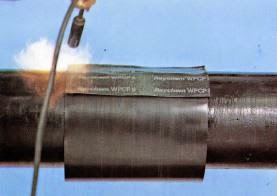
Early versions of these sleeves looked a bit different than what you’ll see today—some even featured a bold “RAYCHEM” print across the closure. But while the appearance has evolved, the core technology has remained remarkably consistent.

At the heart of the system is a high-shear adhesive designed to bond quickly and securely to polyethylene (PE) surfaces. Even under elevated temperatures, the adhesive maintains its grip—an essential characteristic for pipeline integrity.

Over time, enhancements were made to improve performance even further. One key addition was the incorporation of a fiber mesh within the closure, providing extra strength to resist the forces generated by high-shrink materials. These refinements helped ensure reliability across a wider range of conditions.

Expanding the Possibilities

The introduction of WPC didn’t just solve a logistical problem—it opened the door to an entire family of solutions. With this new format, manufacturers like Raychem were able to expand their product offerings to address a variety of applications, operating temperatures, and environmental challenges.

What started as a practical innovation in the field quickly became a foundational technology, shaping the way pipeline coatings would be applied for decades to come.


From a modern perspective, it’s easy to take wraparound sleeves for granted. But back in the 1970s, this was a pivotal moment—one that brought much-needed flexibility, efficiency, and performance to pipeline construction and maintenance.

Monday, January 26, 2026

Raychem / Covalence / Seal for Life WPC100M


WPC100M: A Proven Field Joint Coating with Decades of Reliability


For more than 30 years, WPC100M has been a trusted field joint coating—particularly in offshore applications. Its long-standing track record speaks for itself, making it a familiar and reliable solution for contractors and operators around the world.

One of the key advantages of WPC100M is its butyl mastic sealant, which makes the system extremely forgiving when it comes to surface preparation. Unlike many onshore coating systems, WPC100M does not require an anchor pattern to perform effectively. While it is widely recognized for offshore use, it’s worth noting that WPC100M is also commonly and successfully used in onshore applications.

From a performance standpoint, WPC100M offers impressive temperature capabilities. It is rated for service temperatures up to 212°F when applied over insulated or concrete-coated pipelines, and up to 176°F when in direct contact with soil or the ocean floor. These properties also allow WPC100M to function effectively as a jacket continuation, adding to its versatility in the field.

WPC100M is available in 11", 17", 24", and 34" widths, with custom sizes also available. This flexibility allows it to accommodate a wide range of pipe diameters and project requirements. Combined with a **rapid installation time—often just a few minutes per joint depending on pipe size—**WPC100M helps keep projects moving efficiently without sacrificing performance.

Compatibility is another strong point. WPC100M works seamlessly with nearly all commonly used factory-applied coatings, including polypropylene, making it easy to integrate into existing pipeline coating systems.

With decades of proven performance, fast installation, and broad compatibility, WPC100M remains an excellent choice for a wide range of field joint coating applications—both offshore and onshore.

Tuesday, January 30, 2024

WPCT Mastic Shrink Sleeves

 #1 Mastic Shrink Sleeve:  WPCT

Raychem WPCT
Covalence WPCT (formerly Raychem) Shrink Sleeves

     Once upon a time, Raychem's WPCT was likely the most commonly applied field joint coating in the United States (and Gulf of Mexico).  Once upon a time, WPCT was the cutting edge technology in the field joint coating world.  The market share for WPCT has diminished over the years, but what continues on in the US is (literally) millions of WPCT shrink sleeves in the ground, continuing to offer corrosion protection to oil and gas pipelines that were built each and every single year from 2024, stretching back to the 1970's.  

     Do you know what I don't hear about those millions of WPCT currently protecting critical infrastructure throughout our country?  I don't hear about failures.  I don't hear about problems.  I don't hear about corrosion issues.  I don't hear about problems associated with shielding (please be careful when exposed to propaganda from competitors!).  WPCT's reputations is excellent and it is doing exactly what it was designed to do:  offering field joint corrosion prevention throughout the life of the pipeline.  

     So what is the magic ingredient?  There are two:
  1.   The aggressive butyl mastic sealant.  It sticks to everything.  It flows and it fills around the weld bead and around the factory applied coating stepdown. It's flow capabilities even help it to be "self-healing
  2.   The radiation crosslinked polyolefin backing.  It offers excellent physical protection to the mastic (the actual seal) and makes "applying" that mastic to the proper location, in the proper thickness -- a breeze.  
    What kind of lines are using WPCT?  Primarily smaller diameter pipelines (16" OD and lower)

    What is the temperature rating for WPCT?  Can be used on pipelines operating at up to 140F

    What different widths are available for WPCT Shrink Sleeves?  11.25", 17.75", 23.50" and 34.25" (also able to make any custom width up to 34" that you need).

    What is the pre-heat temperature for WPCT?  140-150F

    Should WPCT be used for ROAD BORE and Directional Drilling applications?  NO - WPCT is not designed for that application.

    What commonly used factory applied pipe coatings are compatible with WPCT?  All of them.

    What is the required surface prep for installing WPCT?  ST3 or SA 2 1/2 are recommended.


Monday, February 22, 2021

WPCT Wrap Around Shrink Sleeves

 WPCT Standard Shrink Sleeves

     WPCT was one of Raychem Corps great advances in the world of heat shrink sleeves that dates back quite a few years.  Many times over the years, WPCT heat shrink sleeves have been the absolute work horse of the Raychem product line.  A very field friendly shrink sleeve; utilizing a butyl mastic sealant; there are literally millions of WPCT shrink sleeves currently in use on underground piping across the world.  Looking only at my little slice of that business; I can say with certainty that we have sold more than one million WPCT shrink sleeves in recent years.  

     In my twenty one years of experience selling WPCT wrap around sleeves; how many "failures" have I heard of?  None.  How is that possible?  The product type and lot numbers are printed on every sleeve.  As we all know; detailed records are kept of pipeline coating solutions that are installed on pipelines across the USA and across the world.  When a corrosion problem occurs; it is quite easy to determine what is going on.  Especially when pipe is dug up and evaluated; it is very easy to determine what has gone wrong with a visual inspection.  And in my decades of experience, I've not had a single call.  Why is that?  

     I believe it is because the thermal indicator built into the WPCT shrink sleeve backing:


     Here you can see what I mean by the thermal indicator.  This is a picture of a partially installed WPCT shrink sleeve.  On the left; we see the backing as supplied.  The cross hatch pattern is imprinted in the backing of the sleeve after the sleeve backing has been expanded (which happens after crosslinking).  On the right side, we see what the sleeve backing looks like after proper installation:  a smooth PE backing.  This is a permanent change (I made this sample several years ago).  This means that the installers have a visible cue during the shrink process to see that they are properly shrinking the sleeve.  This also means that foreman can see that the sleeve is properly installed during and after the install process.

     For inspectors; this is a fantastic tool.  Sleeves can be inspected minutes, hour, days, weeks or months (or years) after the installation.  If there is a pattern on any section of the sleeve --- that sleeve needs more heat!  Simple.  

     In addition to this tool; there are others of course.  Mastic flow should be evident at all edges of the sleeve.  The sleeve surface should be fully conformed to the pipe.  The step down from adjacent factory applied coatings and weld bead profile should be evident.  

     WPCT is a fantastic product - easy to install - inexpensive - reliable.  Hundreds of thousands of currently active pipelines prove that to be the case.


Monday, February 16, 2015

WPC Shrink Sleeve Installation Procedure

Two Piece WPC Heat Shrink Sleeve Install

     WPC sleeves (available in numerous different variations: WPCT, WPC100M, WPC60, WPC80, WPC120, WPC65M - though this post focuses specifically on the mastic coated sleeves and WPCT in particular) are composed of irradiated, modified polyolefin backing which upon brief exposure to a temperature in excess of 125C, will shrink from its expanded diameter (as supplied) to a predetermined recovered diameter.  The WPC sleeves are precoated internally with a controlled thickness of a thermally activated, self priming, rubber modified thermoplastic adhesive that provides an excellent bond to the metal pipe and yard applied coatings.

     During installation the sleeve is wrapped loosely over the joint and closed with a heat activated 'closure' patch (WPCPIV).  The patch is manufactured so that with proper heating the fiber mesh built into the closure backing becomes visible, giving the appearance of an alligator skin texture to the closure strip.

     Internally, the patch is coated with a heat activated high shear adhesive which assures a reliable closure.
Here you see the shrink sleeve and the closure strip as separate parts.
Now on to the install:

Step 1:  Joint Preparation.
  • Remove all weld spatter by grinding, filing or chipping
  • The exposed steel should be power brushed to a near white metal (as with all coatings, the cleaner the surface, the better the bond)
  • The steel and yard coated areas should be wiped clean of foreign materials such as dirt, rust, oil, grease and moisture just prior to installation.
  • The sleeves shall not be applied during rains or sandstorms unless portable welding tents or equivalent are used.  
  • Please note: WPCT (just like WPC65M and WPC100M) requires no primer or epoxy bonding agent.

power wire brush pipeline
Field joint being cleaned with a power wire brush


Step 2:  Preheating of the Joint Area

  •  Preheat the joint area and the adjacent yard coating using a propane torch, induction heater or ring burner.
  • WPCT to be preheated to a minimum temperature of 140F
  • WPC65M to be preheated to a minimum temperature of 165F
  • WPC100M to be preheated to a minimum temperature of 212F
  • It is always necessary to verify the temperature with tempil sticks, contact pyrometer or equivalent. 

FH2601 Torch Kit
Field joint preheating with a JS-2601 Torch Kit

pipeline preheat temperature
Verifying that proper preheat temperature has been reached
Step 3:
  • After preheating (and verifying preheat temp) remove the protective release paper and wrap the shrink sleeve centrally around the weld joint.  
  • The sleeve will overlap itself by at least 50mm

Wrap the sleeve around the pipe

Sleeve will overlap onto itself. 
Closure Patch
Closure secured at sleeve overlap.
heat shrink patch
Closure is secured using torch to activate the high shear adhesive.

shrink sleevepipe coating
Start shrinking on one end of sleeve and work toward other always shrinking circumferentially.

Continue shrinking sleeve until it fully conforms to pipe surface.

The finished WPCT sleeve will be fully conformed with weld bead visible.

Mastic flow will be evident at sleeve edges (this is where the seal is).


Thursday, January 2, 2014

WPC Installation Instructions

Wraparound pipe sleeve for field corrosion protection

WPC

Wraparound Pipe Sleeve for Field Girthweld Corrosion Protection
                                                                                                                                                                   

WPC heat-shrinkable wraparound sleeves are designed for corrosion protection of girthwelds on buried pipelines.

WPC sleeves have a thick radiation-crosslinked polyolefin backing coated with a specially formulated mastic sealant. During installation the mastic flows and fills surface irregularities, bonding to metal and adjacent coating surfaces. The flexible closure is coated with a high shear-strength adhesive and is kitted with the sleeve; however,  it is available pre-attached to the sleeve in the UNISLEEVE construction.

Simple Installation                                                         Resists Adverse Environments
To install, wrap the sleeve around a clean,                                                WPC sleeves resist hydrostatic pressure.           
preheated pipe. A flexible closure forms the                                            They demonstrate high resistance to
sleeve into a tube. The sleeve is then torch-                                             ultraviolet light, fungus, bacteria, cathodic
shrunk around the pipe.                                                                             disbondment and chemical attack by
                                                                                                                    common fluids and solvents.

Rugged and Mechanically Strong                                               Versatile
WPC sleeves resist abrasion, impact and                                                     WPC sleeves are compatible with all
 penetration. No rock-shield is required                                                    standard pipe coatings and outer jackets
                                                                                        including fusion-bonded epoxy, polyethylene,
                                                                                                                     tape and coal tar. The product has a long
                                                                                                                     shelf-life when stored correctly at tempera-
                                                                                                                     tures below 50 degrees C
                                                                                                                                                                       

Materials and equipment
  1. Appropriate size WPC sleeve and WPCP IV closure patch
  2. Raychem torch (or equivalent)
  3. Propane gas tank, hose, regulator and gauge
  4. Standard safety equipment such as gloves, goggles, hard hat, etc.
* Installation has to be done according to local government regulations and usual safety precautions. 
                                                                                                                                                                       

Sleeve Application


1. Clean exposed steel and adjacent pipe                      
coating to be covered by WPC sleeve with a
hand or power wire brush, to remove loose
and foreign materials. Wiping may be
necessary to remove the particles from
cleaning.
Preparing the pipe for WPC applicationNote:
Coal tar - remove outer paper wrap 5" (125
mm) to 6" (150 mm) adjacent to cut-back to
expose coal tar.
 Painted coatings - remove whitewash paint
on the surface of coating to be covered by
WPC sleeve.


2. Preheat joint area until approximately
140 degrees F (60 degrees C) minimum and check for 
conformance either by temperature gauge or other temperature
measuring device. Preheating reduces installation time
and ensures proper bonding.
preheat the joint area preparing of sleeve application
 Note:
Two people working on opposite sides of
the pipe are recommended for installing 
sleeves on pipe 16" (400 mm) in diameter
and larger.


3. Remove the protective release plastic from the
coated sleeve. Center sleeve over the weld so it is
evenly overlapping adjacent pipe coating. Wrap 
loosely around pipe so that the Raychem logo runs
around the pipe.
sleeve application over preheated joint, remove protective release
Note:
1) Clean over lap area of the sleeve to remove
dirt and other foreign material.
2) Edges of sleeve should extend 2" or more
onto adjacent pipe coating.
3) Overlapping ends of sleeve should align evenly.
4)Position overlap to permit easy access for installing closure.


WPCP IV Closure Application


1. Press WPCP IV closure in position, centering over the exposed
         sheet end.(For UNI-sleeve products, the closure is pre-attached 
  and already centered in position.)The sheet should overlap the 
sheet (excluding closure) by 2" (50 mm) minimum. 

Joint Specialist already provides the closure pre-attached read for install


2. Using a Raychem torch (or equivalent), adjust flame length to 
approximately 20" (500 mm) to produce a blue tipped yellow
flame.Using the yellow portion of the flame, heat the closure 
evenly until the pattern of the fabric reinforcement is visible. 

Heat closure with flame, closure application, smooth wrinkles

With gloved hand, pat down the closure and smooth any wrinkles by gently
working them outward from the center of the closure.


Sleeve Recovery


1. Using the Raychem torch (or equivalent),
begin at the center of the sleeve and heat
circumferentially around the pipe using a
constant paintbrush motion.

center sleeve, heat circumferentially, smooth surface


2. Continue heating toward one end of the
sleeve, followed by the other.

continue heatingNote:
Sleeve may be recovered starting at one end
and proceeding toward the opposite end,
depending on conditions (i.e., wind).


3. During shrinkdown, occasionally check
adhesive flow with a finger. Wrinkles should
disappear automatically. Remember to wear
gloves.

remove air void, sleeve recovery
Note:
While sleeve is hot, press roll overlap and
closure area to remove any air voids.


4. Sleeve is fully recovered when all of the
following have occured:
WPC sheet, smooth surface, weld bead profile, conformed to pipe

1) There are no cold spots or dimples on the sleeve surface.

2) Weld bead profile can be seen through the sleeve.

3) After sleeve is cool, mastic flow is evident on both edges.

4) The sleeve has fully conformed to the pipe and adjacent coating.