Visit our website: www.jsicoatings.com
Call: (936) 321-3333
Email: steve@jsicoatings.com
Showing posts with label Covalence Shrink Sleeves. Show all posts

Friday, May 23, 2025

Covalence Heat Shrink Sleeve Applications

 Covalence Heat Shrink Sleeve Applications


Covalence heat shrinkable sleeves, produced by Seal For Life, are engineered for a wide range of pipeline protection and sealing applications. Their robust design and versatile product range make them suitable for various industries and pipeline conditions. The main applications include:

  • :
    Covalence sleeves are widely used to protect the welded joints (field joints) of pipelines from corrosion, restoring the integrity of factory-applied coatings after pipeline sections are joined in the field. This is a critical application for oil, gas, and water pipelines of all diameters.

  • :
    The sleeves provide a tough, abrasion-resistant barrier that shields pipelines from mechanical damage, soil stresses, and impacts during installation and throughout the pipeline’s operational life. This is especially important for pipelines buried underground or exposed to harsh environments.

  • :
    Covalence offers specialized sleeves for sealing joints in district heating and district cooling pipelines, ensuring long-term protection against moisture ingress and thermal losses.

  • :
    Products like the Covalence DIRAX system are specifically designed for high-stress applications such as horizontal directional drilling (HDD), where pipelines are pulled through the ground and subjected to significant mechanical forces. Fiberglass-reinforced sleeves are used for extra strength in these demanding environments.

  • :
    Covalence sleeves are used for retrocoating welded seams, couplings, bolt connections, pipe bends, flanges, and for repairing damaged factory coatings on both new and existing pipelines.

  • :
    The product line includes sleeves for sealing joints in pre-insulated pipe systems, commonly used in district heating/cooling and industrial applications, to maintain insulation integrity and prevent water ingress.

  • :
    Covalence offers sleeves for specific pipeline features such as flanges, sockets, and bends, as well as molded parts for gas distribution networks and accessories for complex joint configurations.

  • Available in both 2-layer and 3-layer systems, with options for epoxy primers and various adhesive types to suit different temperature and service requirements.

  • Compatible with a wide range of pipe diameters and factory-applied coatings, including polyethylene (PE) and polypropylene (PP).

  • Approved by major global standards (ISO, EN, AWWA, NACE, GOST), ensuring suitability for diverse field conditions.

Covalence heat shrinkable sleeves are trusted globally for protecting pipelines against corrosion, mechanical damage, and environmental ingress, making them a leading choice for field joint coating and pipeline sealing across multiple industries.

Wednesday, August 20, 2014

HTLP60 Shrink Sleeves

HTLP60 Shrink Sleeve Coating Handout


raychem shrink sleeve
Cover of a Raychem Handout circa 1985 - HTLP60
     This is the cover of a Raychem HTLP60 shrink sleeve hand out made and in use in 1985.  Personally, I'm not really sure how coating your pipeline with HTLP60 (a great product) is "keeping an eagle eye on your pipeline"; but maybe this supposed to appeal to the US market.  You know how much we Americans love our eagles....how could we turn down any product that uses an eagle as the focal point??
 
     The beautiful thing is that this product has been in use for more than 20 years now, and it been exactly as dependable as it was presented to be back in the 1980's.  Wait, that's probably not actually true.  I would argue that this sleeve has exceeded any expectations.  Back in the "old days" 20 years was often a number thrown around as the life of a pipeline.  As a result, many coatings manufacturers sought to meet that same 20 year life expectancy with their coatings.  Here we are way more than 20 years from the inception and installation of many of our products - and those coatings are still going strong, performing exactly as expected. 
 
     Inside of this hand out you can find the following text:
 
     The HTLP60 system consists of an active modified epoxy primer and a specially coated heat-shrinkable sleeve.  Resulting in a 3-layer anti-corrosion coating with all the virtues of combined epoxy / cross-linked Polyethylene systems, improved impact, adhesion, high temperature and cathodic disbanding performance.  Fully compatible with Fusion Bond Epoxy or Polyethylene line coatings. 
 
     In order to achieve adequate adhesion to steel high performance field joints have in the past required high steel preheat temperatures.  A time consuming, critical and expensive on site operation.  HTLP completely eliminates this preheat. 
 
    To Install HTLP simply:
  1. Sand blast girth weld area.
  2. Flame brush steel to remove moisture
  3. Apply active primer to steel and adjacent FBE
  4. Shrink sleeve using a standard propane torch
     Contractor Advantages:
  1. No induction heaters
  2. No special tools or spray equipment
  3. No refrigerated storage needed
  4. No high preheat hence no potential main coating damage
  5. No critical surface preparation required (anchor pattern)
  6. Field friendly
  7. Low manpower requirements
  8. Does not require highly skilled installers
  9. Allows tie ins and weld skips to be done with ease
  10. Any number of joints crews can install
  11. Lower installed cost
     Pipeline owners and contractors need to keep a sharp eye on corrosion and construction costs.  Not surprisingly therefore Fusion Bonded Epoxy and Polyethylene are increasingly becoming the industry's coating choice.  To complete the on site girth weld area protection of these quality coatings, Raychem has created a unique system, HTLP.


Monday, August 11, 2014

WPCT Shrink Sleeve Certification Short Online Course

WPCT Shrink Sleeve Installer Certification

     WPCT is the Covalence (formerly Raychem) wrap around heat shrinkable sleeve designed to be used as a field joint coating on subsea and buried pipelines that will operate at or below ambient temperatures.  WPCT shrink sleeves have been in use with a high frequency for more than 25 years at this point.  While some folks might read that and think "yikes - that is an ancient coating technology!" I tend to look at it from the other side.
 
     With more than 25 years of use history, WPCT has one of the single largest pools of data ever assembled for a field joint coating.  At my company, we have sold several hundred thousand WPCT shrink sleeves each and every year, dating back to 1995.  All told, I would conservatively estimate that there are currently more than 10,000,000 WPCT coated field joints in the ground or offshore at this exact moment.  Given that incredible quantity of field joints out there, if WPCT were failing or doing a poor job in even 1% of the cases (which would be 100,000 field joints!) we would certainly know about it!  We are the premier source for information on Covalence shrink sleeves in the world.  If there were failures - we would know about them.  If there were consistent issues - we would know about them.  If there were common installation problems - we would know about them.  The simple truth is - we don't ever hear about them.  Not ever.  That tells me that the WPCT failure rate is infinitesimal! 
 
     Because this product has been around for so long, most pipeline contractors have experience with it.  They've installed it.  They've inspected it.  They've buried it.  They've installed over and over and over.  As a result - it isn't very often that we receive a hard request for training or certification on this product.  It is just an easy product to install properly!  Beyond that - every single box should come with an installation instruction guideline right at the top of the box - ready for you to read, to study - or to cast aside as you see fit. 
 
     But still, since there are questions - I wanted to put together an online, simple, basic course that anyone in the world can take as a primer or a refresher to WPCT installation.  My goal is that this course will require no more than 30-60 minutes of your time.  Even better?  This course is absolutely free to anyone out there who is interested in learning more about our products.  As always - I am always available for further discussion and clarification.  Simply email me at steve@jsicoatings.com and I can often be back to you within a few minutes if you're contacting me during common USA working hours. 
 
     So, without further ado - thank you Sir or Ma'am for attending this class.  Let's get started shall we?
 
STEP 1:  Reading about something is always simpler when you know what it looks like.  Step 1 of this short course is to watch our sort - 3 minute - WPCT installation video.  Pay close attention (yes - there is a quiz at the end). 
 
 
     That wasn't too bad was it?  Yes, it has been pointed out to me before that I wasn't wearing the proper safety equipment.  Please - wear the proper safety equipment.  Do as I say -- not as I did in a very controlled, safe environment back when we filmed this video. 
 
STEP 2:  Now you are going to read the installation guideline.  It shouldn't take you more than 2-3 minutes and it very much follows the same steps as the video you just watched.  Haven't studies confirmed that repetition is a key to learning?  I'm not really sure -- but I think so.
 
Please go here to read the WPCT installation Instructions: WPCT INSTALLATION
 
As a general guideline:
1. Make sure you have the proper installation equipment
2. Clean the pipe surface and adjacent factory applied coating
3. Preheat the steel
4. Wrap the sleeve around the field joint
5. Secure the closure
6. Shrink the sleeve - with your torch always moving in an up and down motion (and make sure you have a torch that puts out a broad, bushy, yellow flame.)
7. Check for all the signs of a proper installation
 
STEP 3: The next step is to make sure you've purchased the correct sleeves (or make sure you're getting pricing on the correct sleeves).  At first glance, the nomenclature of a shrink sleeve looks like a giant jumble of meaningless letters.  In actuality though, it is quite simple.  Go to this link - and read this half paged article explaining exactly how you get exactly what you want.  Heat shrink sleeve nomenclature explained. 
 
STEP 4:  In Step 4 we are going to cover two incredibly important....and often overlooked aspects of shrink sleeve installation.  These steps are CRITICAL.  They CANNOT be skipped.  They CANNOT be ignored.  If you pay attention to only one thing during this short course -- pay attention to THIS. 
 
Surface Preparation is one of the most important steps of the installation process.   <-- click the link and read the article, it is short.
 
 
STEP 5:  Get ahead of the game.  Learn what the single most common field issue is with WPCT shrink sleeves.  You'll be pleased to know that the solution could not be simpler (and it only takes 5-10 seconds and a torch to fix). 
 
What is the most common field issue with WPCT shrink sleeves?  <--- click the link and read the article
 
STEP 6:  This is the final step!  You're almost done.  Have you actually read the articles?  I sure hope so.  The final step is a short 10 question quiz which covers much of what I've discussed above.  Unfortunately, you won't get instant results -- but if you take the quiz I will grade it myself and email your score to you. 
 
Take the WPCT Installation short course QUIZ  <--- The final step!  Take the quiz!


Tuesday, November 12, 2013

Covalence Heat Shrink Tubing

Covalence Heat Shrink Tubing and Raychem Heat Shrink Tubing

     This can sometimes get a little bit confusing! I've written previously with a more thorough explanation of the history of Raychem as a brand name, so I will keep things a little bit simpler here.  What ultimately happened, is Raychem kept the name, factory and rights to all of the parts that are typically used in the electrical and energy world.  Covalence ended up with all of the rights to the products that are manufactured for the pipeline world.  As you might imagine, pipelines are typically larger than electrical cables; so ultimately it comes down to size.  Raychem heat shrink tubing is almost always smaller.  Covalence heat shrink tubing is almost always larger.

Covalence Heat Shrink Tubing

     The most commonly sold tubing manufactured by Covalence is the TPS shrink sleeve (stands for Tubular Pipe Sleeve).  This is a heat shrinkable, radiation crosslinked polyolefin backing; coated on the inside with an aggressive mastic sealant.  This mastic sealant bonds to all of the commonly used factory applied pipeline coatings.  TPS heat shrink sleeves are generally only made for pipelines for pipelines 2" thru 8".  This would cover pipe ODs: 2.375" (TPS 2375-18), 2.875" (TPS 2875-18), 3.500" (TPS 3500-18), 4.500" (TPS 4500-18), 6.625" (TPS 6625-18) and 8.625" (TPS 8625-18).  We do also sell TPS in a 9" length (as far as the nomenclature goes; just replace the "18" with a "9".  

TPS shrink tubing
The sleeve on the right is a TPS; tubular shrink sleeve 

     Covalence also manufactures a CPSM shrink sleeve.  We stock the CPSM 195/102-1500-S which is a shrink tube supplied with an ID of 7.677" that will shrink all the way down to a substrate that is 4.01".  This tube is actually 4.92 feet long - so it can be used for a variety of different applications.  CPSM is a high expansion, heavy wall shrink tubing that is coated internally with a mastic sealant meaning that it will bond well to most all surfaces. 

Raychem Heat Shrink Tubing

     Raychem heat shrink tubing, on the other hand, is MUCH smaller - designed for electrical applications and rated for use on certain voltage levels.  WCSM is the most commonly sold shrink tubing: 

heat shrink
WCSM is sold in a variety of sizes; all designed for different wire and connector configurations
     For a more thorough explanation of the different WCSM sizes; visit our page dedicated to WCSM tubing.  WCSM is rated for use to 1000 volts and can be used as a jacket repair all the way up to 35 kV.  
Raychem manufactures dozens of other tubings.  For more information on any of them, visit the electrical blog or our JSI Coatings electrical section.

Monday, September 23, 2013

Heat Shrink Sleeves for Pipelines

     Heat shrink technology has been around for decades.  In that time, there have been many, many different applications and uses for it.  This has ranged from factory electrical uses (read more here) to telecommunications, to heat tracing to the corrosion prevention of pipelines.  Pipeline corrosion prevention is what we will be discussing here. 
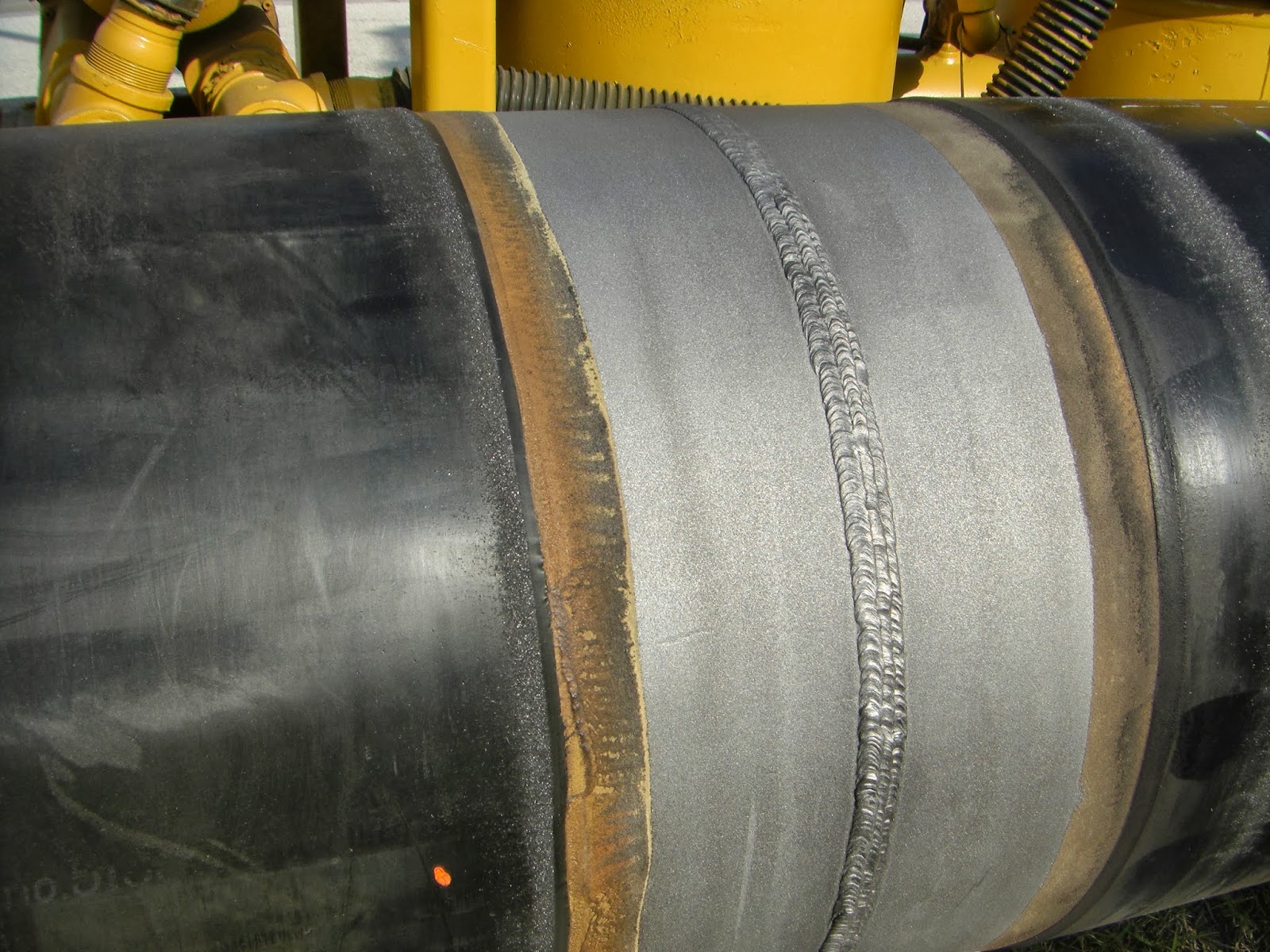
girth weld
Example of a bare field joint on a Three Layer PE (TLPE) coated pipeline.
     Pipelines are generally built in 40 foot segments (you've probably seen a pipe truck loaded with 40 foot joints of pipe driving down the freeway before).  Those pipe joints are coated in a plant; with the most commonly used pipe coating in the United States being FBE.  When these pipe joints are coated in the plant, a small space is left uncoated at the end of each pipe joint.  This is called the 'cutback'.  The cutbacks are there because as the pipe joints are ultimately welded together; any coating right at the ends of that pipe would be damaged during the welding process anyway. 

     So once the pipeline is welded together; what is left (in terms of coating) is essentially: 39.5 feet of factory applied FBE; then 6" of bare steel; then 39.5 feet of factory applied FBE; then 6" of bare steel; then 39.5 feet of factory applied FBE; then 6" of bare steel; etc. 

     This is (of course) a pretty large problem.  Bare steel can corrode very quickly when buried, subsea or even above ground.  A coating has to be put on that field joint (or girth weld).  That is where heat shrinkable sleeves come into the picture as one very commonly and successfully used solution.  As you would expect, we have a variety of options in terms of material types; all designed for different pipeline conditions, temperatures and applications (for a list of the different shrink sleeve coating options we have, see here).